

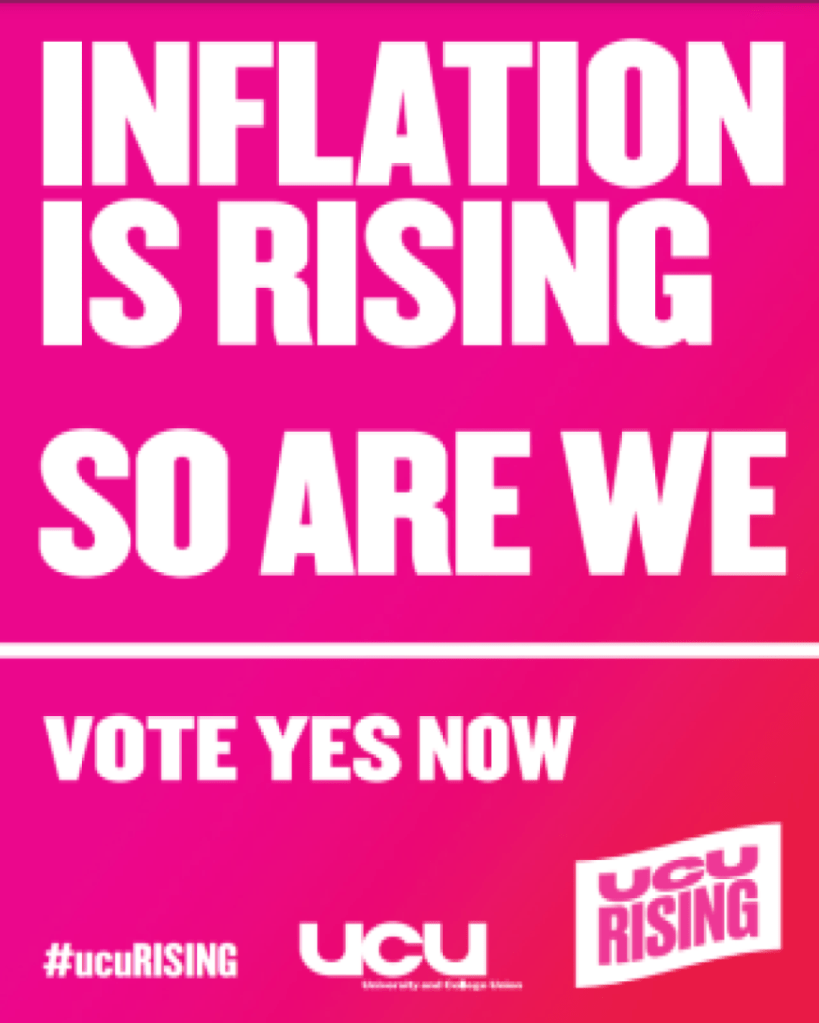
3 weeks ago my #UCURising campaign poster was removed from our staff noticeboard. It must have taken some effort as it was firmly affixed with sticky tape.
I’m curious as to why someone would deliberately remove it and leave all the old and mainly out of date notices about yoga classes, meal deals etc…..
My primary reason for affixing the poster was to highlight the information link for any colleague who wanted to find out why the UCU was in the process of balloting its members on potential strike action.
Strike action, which should the majority of balloted members vote for, will be visible and has the potential to significantly impact many departments across the University.
In fact it’s already made the national news: https://www.itv.com/news/2022-09-25/college-lecturers-launch-strike-action-in-pay-dispute
“A Summer of Strikes and an Autumn of Discontent”
The past few months have seen a marked increase in industrial action by UK trade unions. From the rail unions RMT and ASLEF, to threatened strikes by the CWU (representing telecoms and postal workers), unions are fighting the corner for their members who are experiencing wage freezes, threatened job cuts and the serious impact of inflation and higher living costs on their take home pay.
You may well have felt inconvenienced by some of the actions or in fact sympathised with the members who have resorted to these actions to get their views properly heard by their employers.
#UCURising Campaign – What’s It About?
Members are being balloted on whether to take strike action over:
- Pay and working conditions
- The ongoing USS pensions dispute
These are important concerns being raised by fellow colleagues and workers across the University of Oxford and other HE institutions, that directly impact us all.
Current Situation: Union Response: Some Supporting Facts
1a. Pay Situation
HE employees, (including employees at the University of Oxford) have recently been awarded a 3% annual pay increase, negotiated by the University Colleges and Employers Association (UCEA).
UCU is Calling For
A pay rise of RPI +2% or 12% (whichever is larger) to reflect the inflation rates which are at a 40 year high and have triggered a cost-of-living crisis.
Facts
Since 2009/10, the national HE pay scales have declined in value by 25% relative to RPI, due to a series of below inflation pay increases.
Tip: you can calculate what you should be paid today if salaries had increased with inflation at https://www.ucu.org.uk/HEpaymodeller
1b. Equality Pay Gaps
Situation
HE Employers are failing to take effective action to tackle the persistent gender and ethnicity pay gaps that exist in the higher education sector.
UCU is Calling For
An end to pay injustice. A meaningful agreement with the UCEA to address equality pay gaps.
Facts
Equality pay gaps in the HE sector: Gender =16% Race = 17% Disability = 9%
1c. Casualisation
Situation
Around one-third of all academic staff are employed on insecure fixed-term contracts; this figure rises to almost half for teaching-only academics (44%) and over two-thirds (68%) for research-only staff.
UCU is Calling For
An agreed employer framework to eliminate precarious employment practices and casualised contracts, including zero hours contracts, from the HE sector.
Facts
- The use of casual contracts erodes the rights, protections, and security that should be afforded to all employees.
- Research showed that 42% of staff on casual contracts struggled to pay household bills, 71% said their mental health had been damaged by working on insecure contracts, 43% said it had impacted their physical well-being.
1d. Workload
Situation
The failure of HE employers to protect staff from excessive workloads and stress is damaging health and students’ education.
UCU is Calling For
A meaningful agreement with UCEA on workload to be implemented in Universities.
Facts
Pay inequality and casualisation are all directly interrelated and compound one another. Women, ethnic minorities, and disabled staff were all disproportionately likely to report that their workload had increased, and the same groups are also disproportionately likely to be on casualised rather than permanent contracts.
2. Pensions
In a nutshell, the long running dispute regarding the proposed cuts to the USS pension scheme concerns the valuation conducted by the Universities Superannuation Scheme (USS) in March 2020, as markets were crashing during the COVID-19 pandemic and claimed that contribution rates needed to increase very significantly from the rate of 30.7% of salary (9.6% for members, 21.1% for employers) that was established under the 2018 valuation. The employer representative, Universities UK (UUK), pushed through major cuts to the guaranteed, defined benefit element of the scheme which came into force in April 2022.
However, in June 2022 the scheme reported a surplus of £1.8 bn i.e., a £15.9bn increase on the £14.1 bn deficit that had been reported in March 2020.
The UCU is therefore calling for the benefit cuts to be withdrawn*
Wise Up and Get Your Views Heard
Find out more at the main UCU website: http://www.ucu.org.uk
And please add your views to the debate before October 21st.
By the way, I think the (pink) replacement stickers I have now affixed to the noticeboard will be trickier to peel off quite so easily!
*Note: We are in a slightly different situation at the University of Oxford to employees in other HE institutions though, as the cuts were heavily campaigned against by many of the University’s employees and are still in the process of being debated by the various governing committees and bodies.

 Ox
Ox 
Leave a comment